Showing posts with label EEA. Show all posts

May 22, 2025

The gateway to essential resources for biological invasions

Invasive alien species (IAS) pose a major threats to global biodiversity, as recently highlighted by the IPBES assessment, nevertheless 83% of countries globally do not have a legislation specifically dedicated to address invasive alien species. A notable exception is the European Union, where the policy framework to deal with biological invasions is relatively robust, particularly thanks to Regulation (EU) No 1143/2014. At the core of this legislation is a list of IAS of Union concern, which currently includes 88 species. This legislation has been always characterised by an inclusive and evidence-based approach to policy-making, thanks to the conspicuous work regularly carried out at the science-policy interface. Advancing scientific knowledge has been fundamental to both the shaping and implementation of the EU Regulation on IAS from the start. On the other hand, its enforcement has generated a vast amount of valuable data and information, relevant across diverse fields, from wildlife management and biology conservation to social science and humanities. 

Specifically, during the ten years of implementation of this legislation the European Commission has developed extensive resources - approximately 300 documents and tools - to support Member States to take action in a coordinated and effective way. These include, among the others, risk assessments, notes on measures and costs for the management of over 100 species, manuals for the management of vertebrates (including welfare issues), identification guides for field and customs (along with posters and cards for awareness raising purposes), reports on nomenclature and taxonomical issues, manuals for surveillance systems (including case studies), guidance for the interpretation of CBD pathway categories, pathway management analyses with a focus on e.g., ants, wasps, flatworms, as well as specific reports o soil, topsoil, use of chemicals, the role of alien species in the spread of zoonosis, etc. While many of these documents focus on the 88 species of Union concern (as well as species proposed for listing and many others), many have broader relevance, extending beyond Europe. 

Navigating this incredible amount of resources made freely available online by the European Union and related agencies, can be sometime challenging and requires some familiarity with the relevant webpages and portals. Here’s a guide to key starting points:

For a more comprehensive collection of readily accessible resources, the CIRCABC represents a crucial repository, which includes two separate primary libraries:

  • Invasive Alien Species. Here it is possible to explore a moltitude of documents and reports collected in several folders.
  • Scientific Forum on Invasive Alien Species. Particularly valuable for risk assessments made of species currently in the Union list, but also those which did not qualify or that are proposed and are being discussed by Member States.

Information on hundreds of projects on alien species management funded by the European Commission through the LIFE programme, along with the many outputs produced by each of them, can be found by exploring the online LIFE Public Database.

Another valuable resource is the EASIN website managed by the Joint Research Centre (JRC) of the European Commission, where it is possible to directly access a fair amount of resources. Besides hosting a number of useful technical documents, EASIN hosts data management platforms (EASIN catalogue, EASIN geodatabase), capacity-building resources, stakeholder engagement platforms, and more importantly NOTSYS - the European Alien Species Information Network Notification System - an extremely powerful tool aimed at facilitating notifications about new IAS observations and management measures in real time. 

Also the European Environment Agency (EEA) hosts some repositories with basic documents and tools: 

To easily access species-specific management notes and other similar documents, it is also possible to visit the IUCN webpage of external resources for invasive alien species.  
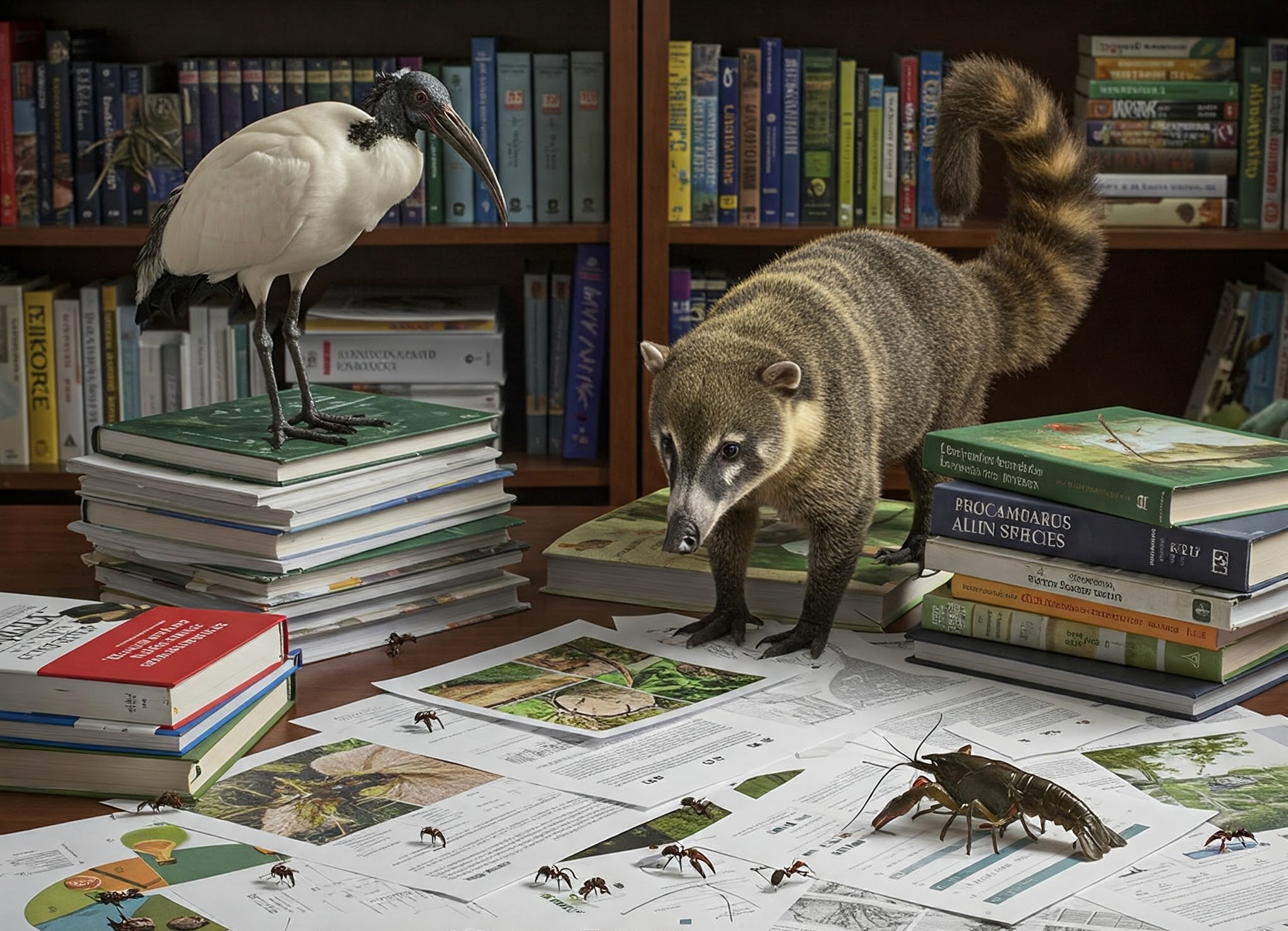
AI generated image (Gemini 2025)

In a world of complex and interconnected environmental challenges, biological invasions demand timely and coordinated action. The EU Regulation on IAS stands as a powerful tool in mitigating anthropogenic impacts. Its effectiveness, however, hinges on the availability and analysis of accurate, up-to-date information. Data, reports, monitoring systems, and scientific studies are not just supportive, they are foundamental pillars for targeted, transparent, and responsible environmental law implementation. A data-driven approach ensures precise interventions tailored to ecological needs, preventing ineffective or harmful decisions. The resources highlighted above, while not exhaustive, demonstrate the substantial body of knowledge dedicated to invasive alien species and the significant commitment of institutions like the European Commission in coordinating, developing, and disseminating vital tools and guidance for tackling biological invasions globally. 

December 20, 2012

What's wrong with alien species in Europe?


Invasive alien species are known to have a high impact on European biodiversity, as well as on human activities and health, and their sound management offers one of the few concrete examples of effective measures able to reduce biodiversity loss. Nevertheless, due to a lack of information and awareness, the issue of IAS and their impact has been often underestimated and adequate prevention and mitigation measures are thus lacking. To overcome such problems, also in support of the new coming EU legislation on invasive alien species (IAS), the European Environment Agency (EEA) has published two reports focusing on IAS impact and relevant indicators:
Both reports have been realised by a multinational team of experts in collaboration with the IUCN/SSC Invasive Species Specialist Group (ISSG), in the context of the continued support provided to the European Commission in its efforts to develop an EU legislative instrument to deal with the problem of biological invasions.


The report on “The impacts of invasive alien species in Europe” includes a description of the multifaceted impact of 28 alien species selected among those known to cause significant harm to biological diversity, socioeconomic values and human health in Europe. In fact, in recent times the true extent of the pervasive threat posed by IAS in both terms of ecological and socio-economic impacts has become much better understood. Scientific researches focusing on the impact of IAS on the environment and human wellbeing have been recently published, including many detailed technical reports made ad hoc for the European Commission.

The report is organised on the basis of the different types of impact by IAS which are gathered together in 14 categories. Such categories include competition, predation and transmission of diseases between alien and native species, as well as the various ecosystem services affected. Indeed some IAS might have an impact on a specific ecosystem service, or may affect multiple ones. There are also IAS acting as vector of disease and affecting human health, as well as IAS making extensive damage to infrastructures, landscape, and agriculture. The species selected as example encompass a diverse range of groups that threaten European freshwater, brackish water, marine and terrestrial environments. Such species have been selected because of the significant harm they pose to biological diversity, but given the extent of the problem it is clear that the both lists of species and impacts are not intended to be comprehensive and exhaustive, but only representative of a very complex situation.

Rose-ringed parakeet in Versailles © Photo: Riccardo Scalera

Also the report “Invasive alien species indicators in Europe - a review of Streamlining European Biodiversity (SEBI) Indicator 10” by showing patterns and trends of biological invasions, aims at contributing to raising public awareness of the biological, ecological and socio-economic impacts of IAS. This report was commissioned by the EEA to support the “Streamlining European 2010 Biodiversity Indicators” (SEBI 2010) process, and particularly to revisit and further develop the indicator “Invasive alien species in Europe”. The aim was to critically review and improve this indicator, and propose an updated methodology. Further, options for methodologies of new indicators, which monitor IAS over time across Europe, are discussed. Particular attention is given to closely linking the proposed indicators to the recent biodiversity policy goals and developments. In fact  since indicators reflect trends in the state of the environment and monitor the progress made in achieving environmental policy targets, they have become indispensable to policy-makers. Moreover, indicators enable and promote information exchange regarding the issue, thus communication is their main function. 

Thus, both reports should contribute to support raising awareness and communicating the impact of IAS to all stakeholders as well as the general public by reporting the best scientific knowledge on the issue. Besides, the biodiversity strategy needs to be aligned to the biodiversity knowledge base to underpin policy with up-to-date scientific data and information. The new EEA reports are thus aimed at raising awareness and informing on the environmental and socioeconomic impact of IAS, not only all stakeholders and the general public but also decision makers and policy makers. In this context the report is fully in line with the EEA's mandate “To help the Community and member countries make informed decisions about improving the environment”.