Showing posts with label Pet trade. Show all posts

November 02, 2012

Invasives creeping out of place

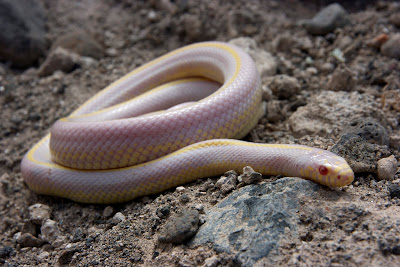
To find the first and only "original" remains of a snake in the Canary islands, in the Atlantic sea, we need to go back to the late Miocene, a geological epoch especially renowned for the repeated desiccations of the Mediterranean sea. Paleontologists have found just one vertebra of what was something like a boa living in the archipelago 5-10 million years ago. As far as we know, since then no snakes lived in the Canary islands, at least until the early 2000, when the archipelago has experienced the very unfortunate introduction of the California kingsnake (Lampropeltis californiae). This species, probably escaped or released from captive facilities, is now an important environmental problem in the archipelago due to the enormous social alarm among the population not accustomed to the presence of snakes, and the damage caused to many endemic reptile species, such as the Gran Canaria giant lizard (Gallotia stehlini). To remove this major ecological threat, over 1000 snakes were captured since 2007, and now thanks to the 1 million euro Lampropeltis project supported by the EU through the LIFE+ programme, the authorities expect to set up the conditions for the eradication of the species.


.California kingsnake (striped albino pattern) Photo © Ramón Gallo Barneto
California kingsnake (striped albino pattern). Photo © Ramón Gallo Barneto

The lucrative trade of species for pet amateurs carries the inherent risk of escape or abandonment of animals kept in captivity, and as a consequence the potential establishment of wild self-sustaining populations of a number of invasive alien species. In fact the California kingsnake is only one of the many species known to have succeeded in getting naturalized outside their native range as a side effect of the pet industry. Another major example among the snakes is the Burmese python (Python molurus bivittatus) in the Everglades, Florida. The spread of this species is a major concern in the region, because it is a predator that can grow over 5 metres long, and as such is able to eat nearly any native animal, possibly even panthers and alligators.

Snakes are often introduced also as cargo stowaway. In this way many species manage to colonise even remote oceanic islands, where they can represent a serious threat to some of the most and unique living creatures of the world. A renowned case of accidental introduction concerns the brown tree snake (Boiga irregularis). Soon after World War II this native of the Solomon islands, northern Australia and Papua New Guinea, was transported as stowaway by military cargos to the island of Guam, Mariana Islands. In this 
western Pacific island this ecologically disrupting predator is having a dramatic ecological and economic impact. In particular is negatively affecting several species beside having killed off at least 8 of the island’s 11 species of native birds, as well as some indigenous lizards and bats. Now there is a growing concern that the species could take advantage of the frequent aircraft flights from Guam to the Hawaii and make its way to this archipelago in central Pacific, where its ecological and economic impact would be even greater (according to some studies it might cost over 1.7 billion dollar per year if successfully introduced).


Brown Tree Snake. Photo © Daniel O'Brien

Accidental introductions linked to military activities are likely to have occurred also in ancient times: perhaps snakes were used to frighten enemies even during Roman assaults. As suggested for the origin of the viperine snake (Natrix maura) in the Balearic, Spain, some introduced populations of snakes in the Mediterranean islands could be actually linked to such battle related events. Also this snake is having a major ecological impact in terms of loss of indigenous species, and changes in community structures and function. In fact in the Balearic Islands, the introduced viperine snake is known to represent a serious threat for the endangered endemic Mallorcan midwife toad or ferreret (Alytes muletensis) in Mallorca, and was probably involved in the extinction of the species in Menorca.

Other than inflicting ecological harm, non-indigenous snakes can be dangerous to humans, as some species are also poisonous. A typical poisonous snake introduced outside its natural range is the habu (Trimeresurus flavoviridis), a Japanese native viperid introduced in Minnajima, Okinawa Island. Also the brown tree snakes is well known for its venomous bites: in Guam the estimated cost for hospitalisation and intensive care for people affected by snakebite (especially infants) is about 25,000 dollars per year. Along with the ecological damages and the health problems, the brown tree snake can also provoke significant economic impacts, like frequent power outages and damage to the electric lines due to the attitude to crawl along the wires: yearly cost for direct damages and lost productivity is conservatively estimated at 1 million dollars.


Thus, nothing to do with the notorious old rumor, still very popular in countries like Italy, according to which snakes, and particularly vipers, are recurringly broadcasted by helicopters - by either environmentalists or parks authorities - to restore their wild populations. Here the problem for nature conservation professionals is how to prevent the further release or spread of snakes and other harmful alien species outside their natural range, where they clearly represent a key driver of biodiversity loss.

October 22, 2012

Short story of a pet turning into pest

Every year since 1928 a competition takes place in Angels Camp, California: the Jumping Frog Jubilee, a popular event inspired by Mark Twain’s famous short story The Celebrated Jumping Frog of Calaveras County. At the time - the story was first published in 1865 - the now endangered California red-legged frog (Rana aurora draytonii) was very common in that area: thus this was probably the species used for the competition and to which the story refers. However, at the end of the 19th century a new non-indigenous species entered the scene: the American bullfrog (Rana catesbeiana). Soon after being introduced into the area, the bullfrog replaced the indigenous red-legged frog within the Calaveras competition, and since 1986, thanks to Rosie the Ribiter and its jump over 6.5 m, the American bullfrog has held the world record!


Mark Twain portrait by Frederick Waddy

Nevertheless the greatest ultimate jump that the species managed to perform, with substantial help from human agency, has been through the Atlantic Ocean, from the New to the Old World. And it was definitely a very fortunate jump!

Like many other frogs, this typical edible species has experienced several introductions throughout the world for human consumption, often linked to the restaurant trade, but also for the pet trade. This “gourmet” indigenous to North America, was considered particularly suitable for aquaculture and has been frequently farmed for commercial production in countries outside its native range. The result is that the species is now spreading in several countries and islands worldwide, mainly as a consequence of escapes from breeding facilities (but also from garden ponds), or following intentional releases aimed at establishing wild populations to be regularly harvested. Thus, not surprisingly today the American bullfrog is thriving into many countries throughout the world, including several European countries (e.g. Belgium, France, Germany, Greece, Italy, the Netherlands, Spain, and U.K.).

The American bullfrog in Italy © Photo: Riccardo Scalera
The American bullfrog in Italy © Photo: Riccardo Scalera

Unfortunately, the species is also considered a serious ecological threat for indigenous species. Indeed it is a voracious opportunistic predator, eating a wide range of preys, from insects and other invertebrates to several vertebrates, including amphibians and reptiles, small mammals, and birds. Competition dynamics with indigenous species are also known to occur, as it may compete for food with indigenous amphibians, at either adult or larval stages. The American bullfrog may also bring the inherent risk of spreading harmful pathogens, like Chytridiomycosis. This fatal disease caused by the fungus Batrachochytrium dendrobatidis has been associated with a number of amphibian declines and extinctions in geographically disparate parts of the world.

In economic terms, although extensive studies on the impact of this species are not available, figures related to local situations show that their management may be very expensive. In the U.K., for instance, early efforts to remove the first breeding bullfrog population to protect native wildlife cost some 32 000 Euro. In Germany the annual cost for measures to control a few bullfrog populations (in only five ponds) was calculated to be 270 000 Euro, but the cost for control would rise to 4.4 billion Euro in the event that this species spreads throughout Germany.

Text excerpted from:

  • Scalera R, 2007. An overview of the natural history of non indigenous amphibians and reptiles. In: Gherardi F. (editor) Biological Invaders in Inland Waters: Profiles, Distribution and Threats. Invading Nature: Springer Series in Invasion Ecology, Springer, Dordrecht, The Netherlands, Pp. 141–160.
  • Scalera R, 2007. Virtues and shortcomings of EU legal provisions for managing NIS: Rana catesbeiana and Trachemys scripta elegans as case studies. In: Gherardi F. (editor) Biological Invaders in Inland Waters: Profiles, Distribution and Threats. Invading Nature: Springer Series in Invasion Ecology, Springer, Dordrecht, The Netherlands, Pp. 669–678.